SUMMER 2026
HALF WINGED
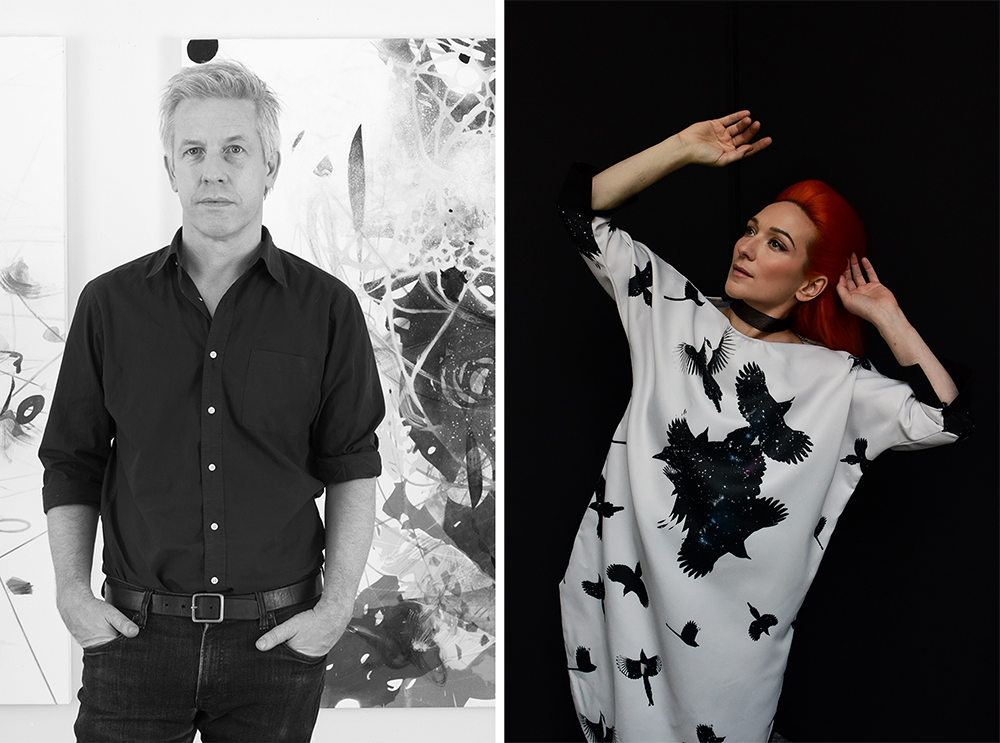
Matthew Ritchie + Shara Nova
May 16 – August 15, 2026
RECEPTION: Saturday, May 16, 5-8pm
Half Winged is an immersive musical and visual installation built around a single, devastating question, Are we truly free?
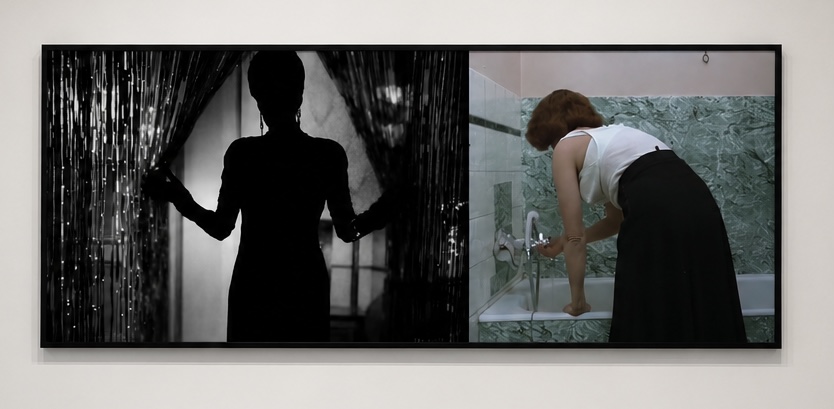
Created by longtime collaborators, composer Shara Nova and visual artist Matthew Ritchie, Half Winged is a choral cantata — part song cycle, part ritual, part elegy — that maps humanity’s oldest pattern: the drive to build something new, something bigger, something more beautiful, only to question it, destroy it and begin again.
This ambitious yet accessible work is anchored in a magnificent 70 minute recursive musical score recorded using a spatialized Atmos sound system and featuring an extraordinary ensemble of singers, AI programs, live and recorded instruments.
Addressing pressing contemporary issues of choice and the impact of technology by drawing on and remixing fragments of texts ranging from the Enuma Elish to Paradise Lost, W.E.B. Du Bois’ Princess Steel, Walter Benjamin’s Angel of History, and Paul Klee’s Pedagogical Sketchbook; Half Winged gives this pattern a structure through a cast of characters in a feature-length multi-screen AI-generated video, named after the programs used in Large Language Models. The Discriminator, entropy’s angel forever facing backward, ; the Generator, the wind of change pressing blindly forward; the Transformer, the Witness, the Gardener, the Weaver, and finally the Child — a character voiced entirely by artificial intelligence — who returns, across every act, to the same unanswered question:
Are we truly free?
AI is a new form that combines old questions with new hazards, not only allowing us to envision multiple futures, but to rediscover and reimagine lost histories, blurring ‘what-might-have-beens’ with myths of creation, choice and crisis repeated across every age. Like any new technology, AI can seem almost immune to conventional standards of judgment. Not a single image you will see in this video installation is real. Everything is just computer code, generated by a machine trained on movies and the internet. This ‘generated’ material is highly problematic in many, many ways. AI cannot see or understand how it absorbs creativity, reflects inequality and causes environmental destruction. At the same time, AI’s inherently inhuman indifference to traditional representation can potentially also allow us to see our own strange and increasingly distant creation stories more clearly.
With that in mind, this work seeks to use the lens of AI to examine and interrogate one of the most basic questions we ask in all our creation stories.
Are we truly free?
The installation is accompanied by a large series of watercolors and the music will be released as a double album later this year.
This project was generously supported by the Knight Foundation.
About Matthew Ritchie
Matthew Ritchie’s environmental installations of paintings, wall drawings, light boxes, games, sculpture, films and performance works are a continuous investigation of the idea of embodied information, explored through a shared universe of interconnected stories and images that draw from art, architecture, science, fiction, history and the dynamics of culture, all unified by a unique, shared visual language.
In 2001, Time magazine listed Ritchie as one of 100 innovators for the new millennium, for exploring “the unthinkable or the not-yet-thought.” His work has been shown in numerous exhibitions and museums worldwide including the Whitney Biennial, the Sydney Biennial, the Sao Paulo Bienal, the Venice Architecture Biennale, the Seville Biennale and the Havana Biennale. Solo exhibitions include; Dallas Museum of Art, Contemporary Arts Museum, Houston, Institute of Contemporary Art, Boston, Mass MoCA, Moody Center for the Arts, Portikus, St Louis Museum of Art and ZKM, His work is in the collections of the Museum of Modern Art, the Guggenheim Museum, the Whitney Museum of American Art, the Albright Knox Museum, the San Francisco Museum of Modern Art and numerous other institutions worldwide.
Ritchie was born in 1964 in London, graduated from Camberwell College of Art (BFA) in 1986 and emigrated to the United States in 1987. He is currently a Mentor Professor in the Graduate Visual Arts Program at Columbia University, New York and the Dasha Zhukova Distinguished visiting Artist in Residence at MIT. Awards include the Baloise Art Prize, a National Association of Art Critics award, an ID design award, the Federal Art In Architecture National Honor Award and an honorary Doctorate in Fine Arts.
About Shara Nova
Shara Nova is a composer, vocalist, and interdisciplinary artist whose work moves fluidly between indie rock, contemporary classical music, opera, and large-scale participatory performance. She has released six albums under the moniker My Brightest Diamond and has built an expansive career writing for professional ensembles, community choirs, and orchestras while maintaining an active international performing life.
Her choral and vocal compositions have been performed by The Crossing, Conspirare, Cantus Domus, Roomful of Teeth, Brooklyn Youth Chorus, Detroit Opera’s Touring Company, and numerous university and community choirs. Nova has composed orchestral and chamber works for yMusic, Brooklyn Rider, Aarhus Symphony Orchestra, Cincinnati Symphony Orchestra, North Carolina Symphony, Indianapolis Symphony Orchestra, American Composers Orchestra, and the BBC Concert Orchestra, among others.
Her honors include fellowships and awards from Kresge Arts, Carolina Performing Arts Creative Futures, Knight Foundation, United States Artists, New Music USA, and Opera America. Recordings featuring her work with Conspirare and The Crossing received multiple Grammy nominations in 2023.
About the Collaborative Project
The project began in 2019 by asking an early and far less sophisticated form of Open AI’s program called Chat GPT 2 (Generative Pre-trained Transformer), to write a script based on three primary prompts. The remains of the first modern humans were found in Tanzania: what would Adam and Eve look like? If the first humans were described as being ‘in the image of God’: what would God look like? If Paradise Lost is the tale of different kinds of created intelligences questioning the nature of free will: what would Paradise Lost mean to Artificial Intelligences (or programs)?
Open AI’s Sora and Runway ML were used to generate multiple scenes.
The artists’ own prior collaborations were used as the primary prompts for visual generation – although it seems that the flying monkeys from the Wizard of Oz and elements of Dune also somehow crept into the Large Language Model underlying Sora.
Sora closed on April 26, 2026. It was the most expensive failure in AI history.

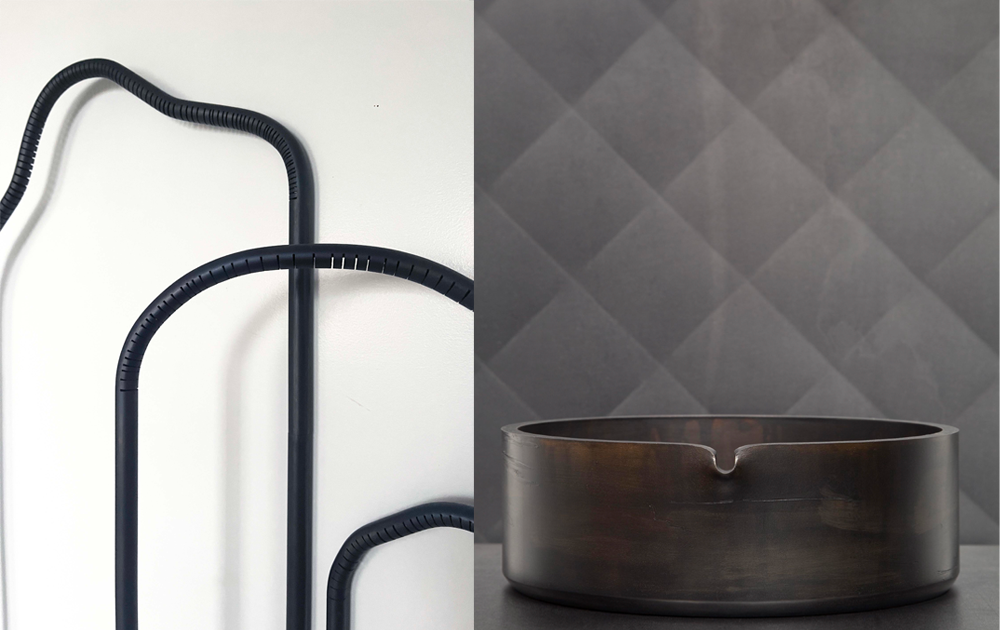
Steel Work of Mild Hands brings together recent works by Alberte Tranberg and Adam Shirley, two artists whose practices engage deeply with metal as a site of labor, time, and material decision-making. Shown within the context of the SNAG (Society of North American Goldsmiths) Conference 2026 in Detroit and hosted by Wasserman Projects, the exhibition connects individual studio practices to broader conversations about making, effort, and value in contemporary metal and jewelry. Rather than approaching metal as a neutral medium, both artists foreground labor as an active and visible component of the work. Processes such as cutting, bending, joining, and repeating are not hidden but allowed to remain present, shaping both form and meaning. In this sense, labor is not only a means to an end, but a way of thinking through material.
Presented together, the works create a dialogue around different approaches to metalwork—ranging from precision and control to repetition, accumulation, and wear. The exhibition proposes labor as a shared ground, while allowing distinct positions to emerge through material choices, scale, and process.
Steel Work of Mild Hands is on view from May 16 – June 13, 2026
About Adam Shirley
Adam Shirley’s works arise from an investigation into the relationships between two and three dimensional objects, material and scale. Shirley explores form and volume in model-sized flat pieces that leave the interpretation of scale and function open to the viewer.
Working primarily with steel, a material typically associated with utility and function, Shirley creates objects that exist in a state “somewhere between a thought or idea and the process of transformation into physical form.” The results are works that engage the viewer into exploring the potentials of each object or form, not so much to arrive at a a definition of what they are, but simply to enjoy the journey of envisioning what they could be.
Adam Shirley received his BFA in 1993 from the College for Creative Studies (CCS), in Detroit, Michigan, and a Master of Fine Arts in Metalsmithing Department at Cranbrook Academy of Art, in Bloomfield Hills, Michigan, in 2010. Shirley has recently received the Louis Comfort Tiffany Foundation award.
About Alberte Tranberg
Alberte Tranberg (b. 1990, Copenhagen) is an artist and metal fabricator who earned her MFA in Metalsmithing from Cranbrook Academy of Art, in 2018. She is a 2016 Fulbright recipient and was a Penland Winter resident 2025.
Tranberg engages the performative nature of interior objects through subtle architectural interventions. Her approach to making is a responsive dialogue between material and tool, whilst shaping gestures of familiar forms to emotive narratives.
She has exhibited at Devening Projects (Chicago, IL), Buffalo Institute for Contemporary Art (Buffalo, NY), Ornamentum Gallery (Hudson, NY), Materia Gallery (Detroit, MI), BULK Space (Detroit, MI), and Kunsthal Charlottenborg (Denmark), and has designed an award-winning series of handles for Reform Kitchens. Her work has been presented at the 5th edition of the Venice Design Biennial and featured in Special Exhibitions at Season Contemporary Fair (Detroit, 2025). In collaboration with Iris Eichenberg as BERG+BERG, Tranberg has presented work with Ornamentum at Salon Art + Design (New York, NY) and Design Miami (2021).